← All insightsAI-assisted engineering · 24 October 2026
2nd Engineer: AI coding is fast. Second opinions should be, too.
A practical guide to adding an independent, real-time second opinion while an AI-assisted development approach can still be reconsidered.
By Alchemy Loop
AI-assisted development is changing the rhythm of a technical team. More implementation choices can be explored and more code can be produced in less time. That speed is useful, but it does not remove the need to check the reasoning, the trade-offs or the work that has not yet been considered.
The problem is not that a developer or a primary AI is necessarily wrong. It is that a fast-moving approach can become the default before a team has taken a different look at it. A second opinion is most useful while the design, fix or technical claim is still live—not after the code is merged and the context has gone cold.
Independent does not have to mean slow
Traditional review is valuable, but it often waits for a pull request, a meeting or an already-formed decision. A real-time independent review runs alongside active work. The team states its current position, a different AI examines the available repository context in a read-only role, and the two views can be compared before the next commitment is made.
That is the idea behind 2nd Engineer: an independent second opinion that helps the team determine whether the primary approach is still the right path. The reviewer advises; people keep the decision.
2nd Engineer dashboard
Real-time review, visible to the team.
The dashboard shows consultations in flight alongside response timing, usage and the human-assigned impact of completed second opinions.
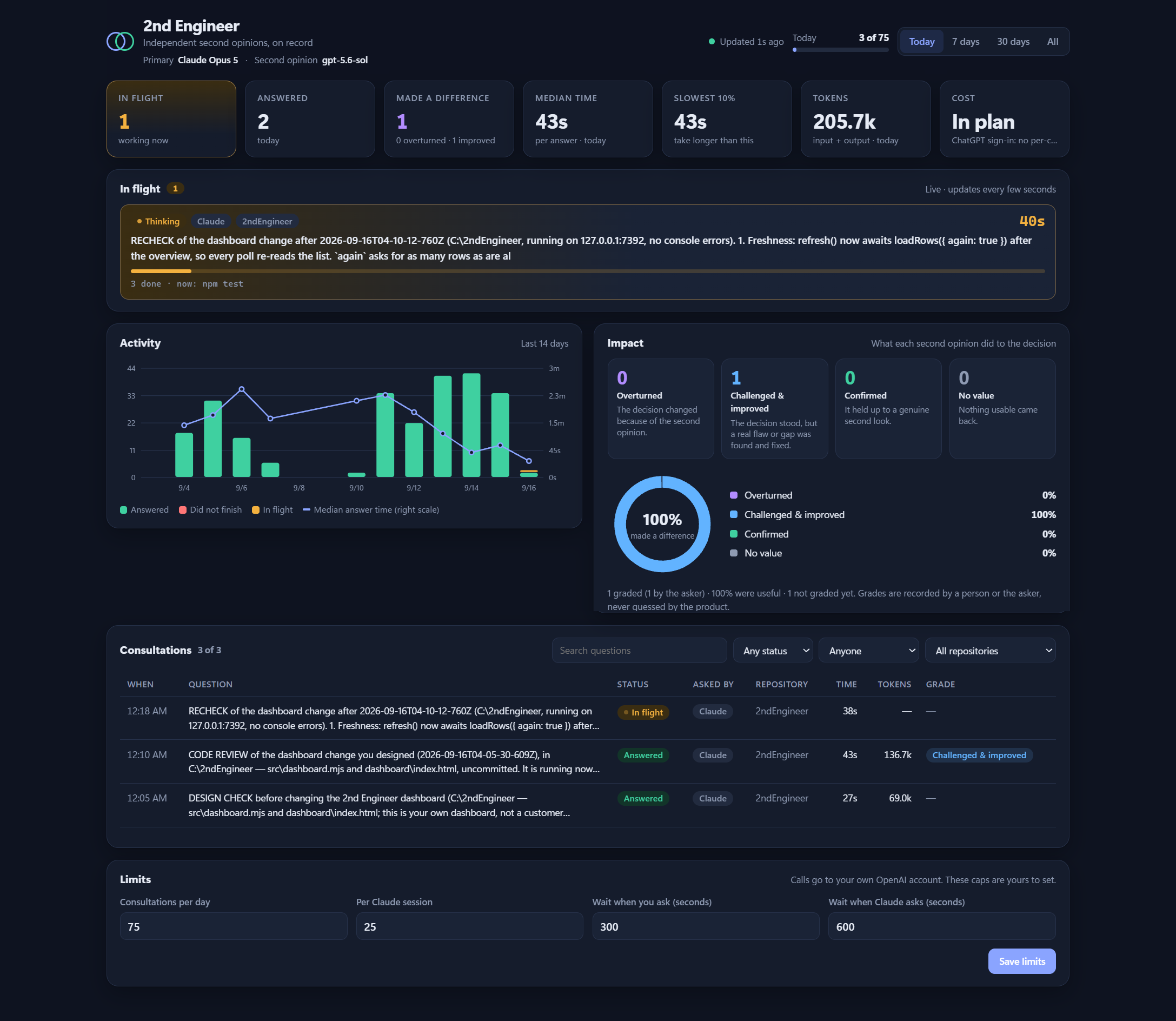
Representative dashboard view · fictional demonstration data
What the second look is for
Four questions worth asking while the work is in progress.
01Assumptions
Has the primary approach made a technical assumption that deserves a second look before it becomes a dependency?
02Approach
Is there a safer, simpler or more maintainable way to solve the problem before the team commits to the current path?
03Gaps
Are there edge cases, risks or missing tests that are easy to overlook when a team is moving quickly?
04Record
Can the team later see the prior position, independent response and the human-assigned outcome in one place?
How 2nd Engineer keeps the role clear
2nd Engineer uses different AI models in reversible author and reviewer roles. Claude can do the primary work while OpenAI provides the review, or the roles can be switched. The point is not to make one model permanently “right”; it is to introduce a genuinely independent perspective into the moment where it can help.
The reviewer is advisory and read-only. It may inspect repository files and run permitted read-only commands, but it cannot edit, merge, commit, revert or release code. The human team retains authority over the next move.
For engineering managers and technical leaders, the review becomes more than an anecdote. The prior position, independent response, model, elapsed time, token use and human-assigned outcome can be retained together. Teams can distinguish a review that confirmed the direction from one that challenged and improved it, or one that changed the decision altogether.
A second opinion is an operating habit
The value is not in asking an AI to pronounce a verdict. It is in making room for a different line of reasoning while the work is still flexible. As AI makes output faster, this small discipline helps teams preserve the part of engineering that speed alone cannot provide: deliberate judgement.