Every row retains its page.
 Back to products
← Alchemy Loop portfolio
Mortgage Proof of Claim Attachment · Official Form 410A
410A Claim Assembly
From servicer histories to a traceable, audited draft claim package.
Upload the payment histories and supporting records. 410A Claim Assembly reconstructs the transactions, performs the calculations, checks the balances and organises the evidence behind a draft your team can verify.
CLAIM PACKAGEREADY FOR REVIEW
PAYMENT HISTORYBalances reconstructed
TO THE CENTBreaks are reported.
A person resolves exceptions.
6 SPREADSHEETSSOURCE EVIDENCEPLEASE CHECK LIST
The work behind the claim
The form is short. Reconstructing the numbers behind it is not.
Payment histories can span multiple servicers, scanned pages, coded columns, suspense activity, escrow advances, fees and payments applied to earlier months. The product turns that collateral into a reviewable draft without hiding the source or the exceptions.
PAYMENT HISTORIESPRIOR SERVICERSESCROW ANALYSISATTORNEY FEESPETITION DATE
From upload to review
Hours of spreadsheet work, assembled and shown.
- 01
Upload the histories
Provide payment histories as PDF or Excel, including prior servicers when the loan transferred. Add the petition date and, optionally, the firm fee sheet.
- 02
Read every transaction
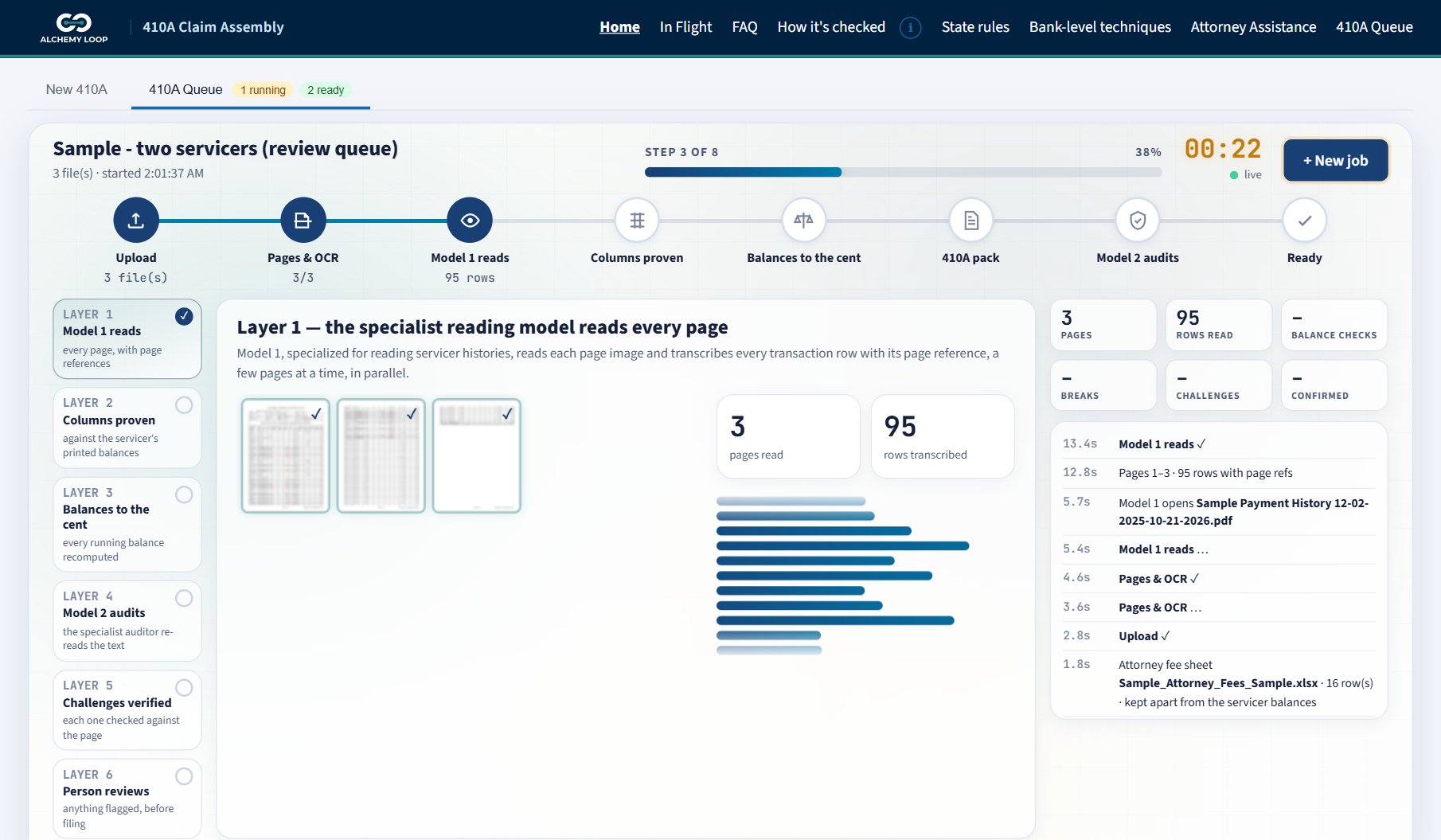
The first model transcribes the records and retains the page behind every transaction. OCR handles scanned and faxed pages.
- 03
Prove the arithmetic
Deterministic calculations identify what each column means, rebuild running balances and report every difference from the servicer's printed figures.
- 04
Challenge the first reading
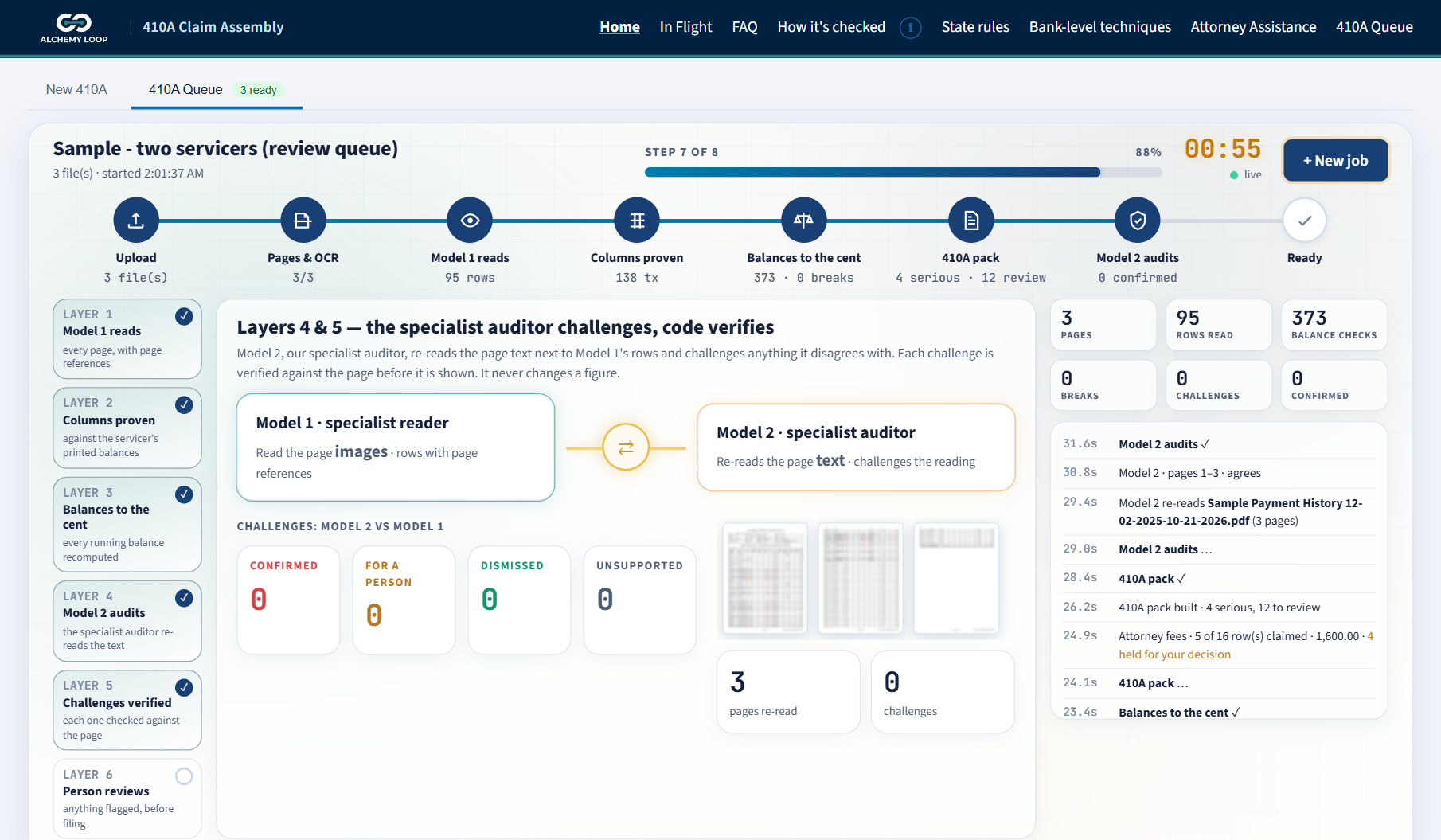
A second independent model re-reads the pages and questions possible missed rows, incorrect amounts and incorrect dates. It cannot silently change a figure.
- 05
Complete Guided Review
Your team works through each decision one card at a time, with the exact source line highlighted, then recalculates the complete draft package.
Inside the application
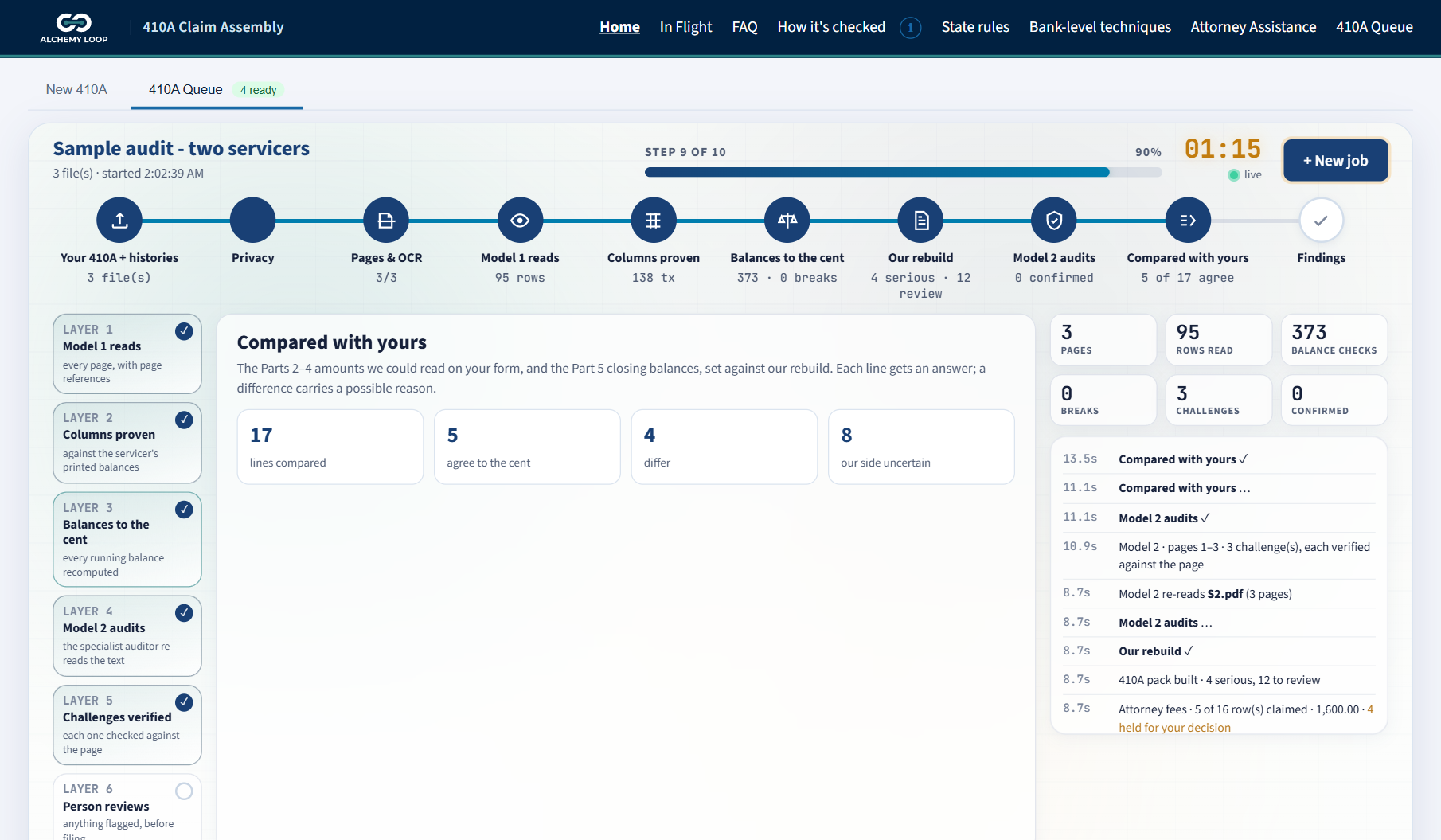
Watch the claim take shape while every check remains visible.
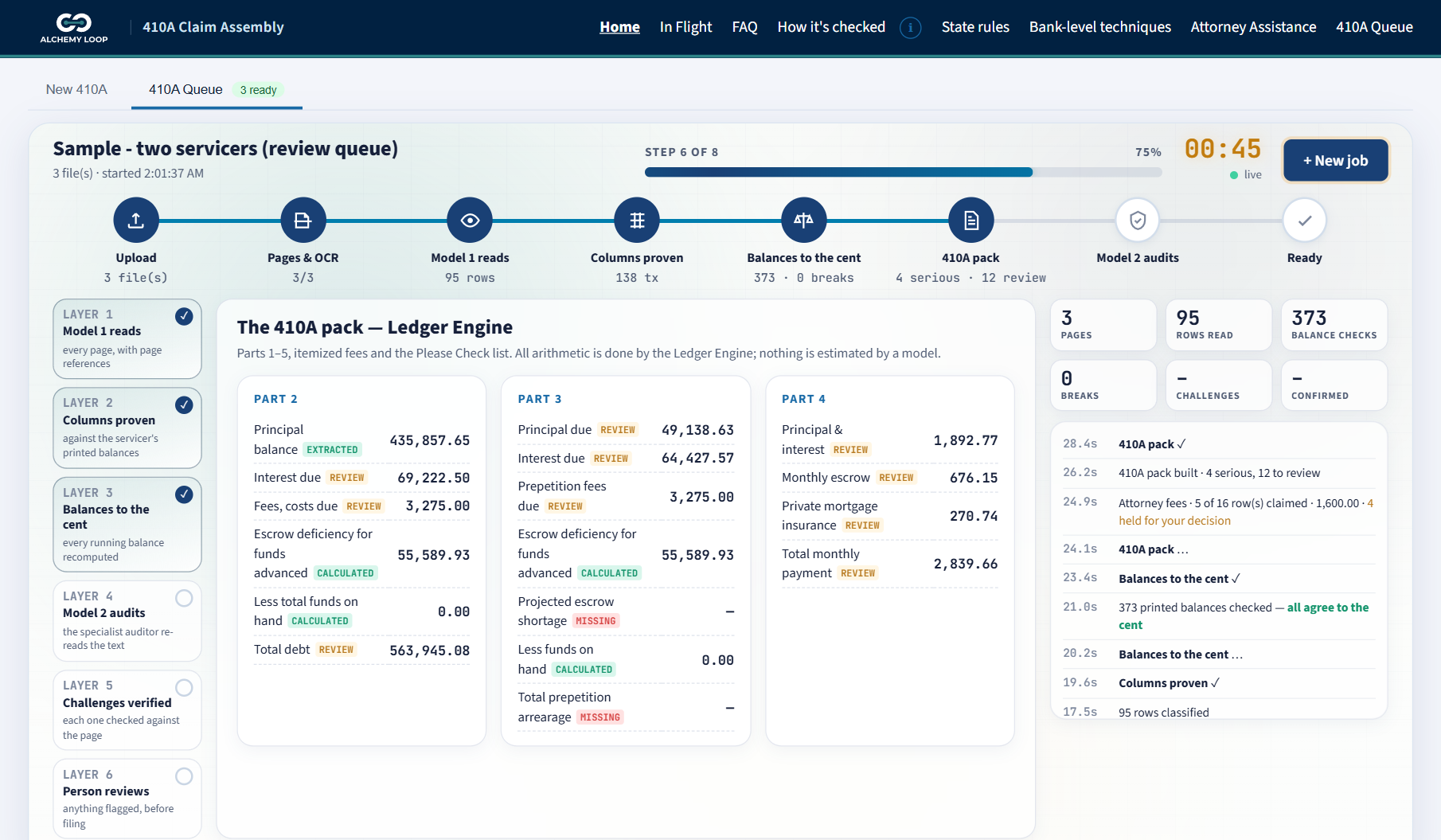
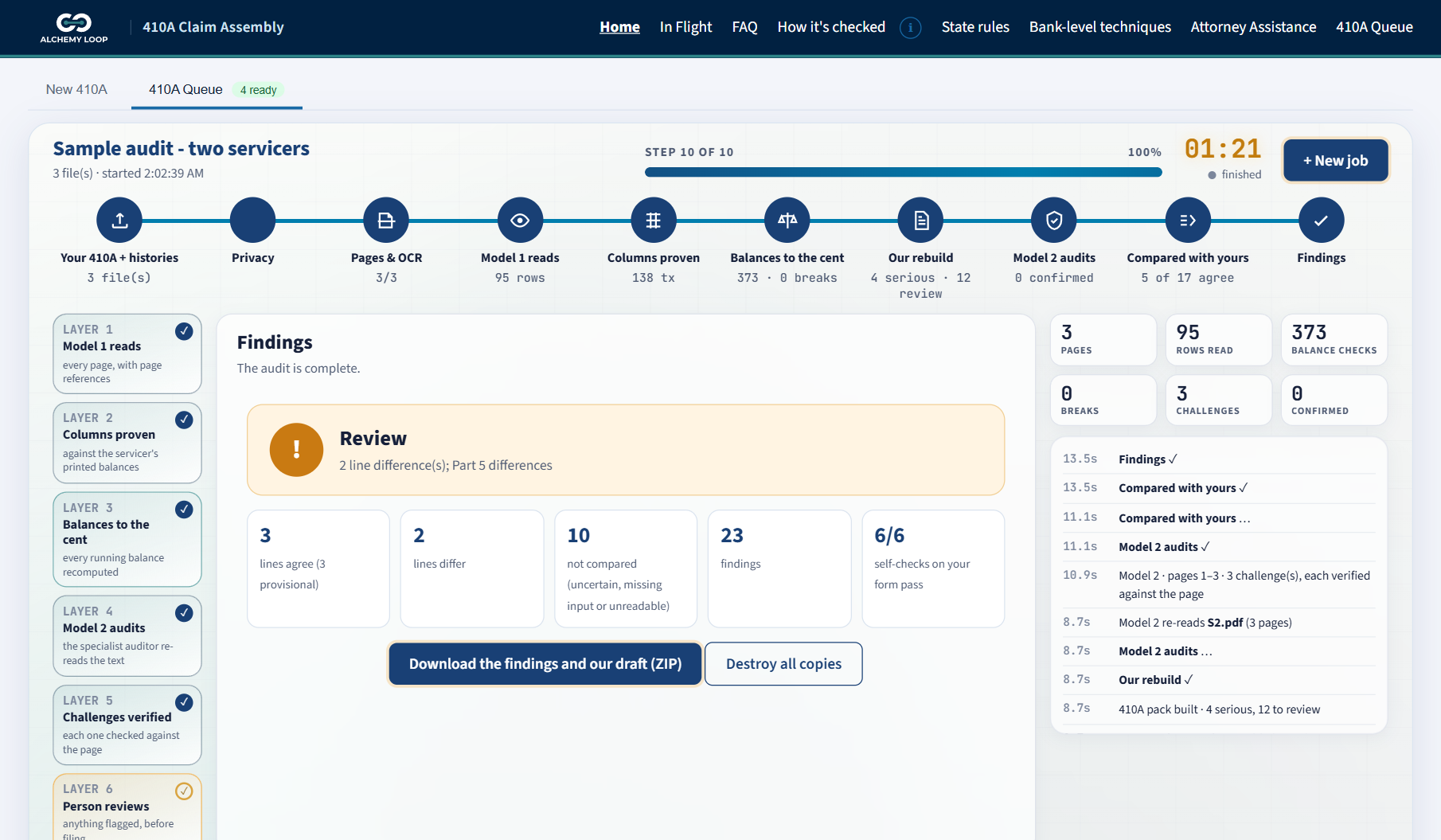
The live workspace shows where the job is, what each layer has completed and which questions still require a person. Sample information is shown throughout these images.
Follow the source documents through reading, reconciliation, claim preparation and the independent second audit.
Guided Review
Every exception becomes a clear, sourced decision.
When the figures are ready, Guided Review walks your team through each item that needs a decision—one card at a time.
See the exact line.
Each card shows a cut-out of the servicer’s page with the relevant line highlighted.
Record your judgment.
Confirm the reading, choose the correct treatment or type the figure shown on the page.
Recalculate the complete pack.
The full package is rebuilt in seconds, with no new document reading and no extra charge.
YOUR REVIEW, RECORDED
Two independent model readings and the Ledger Engine’s cent-level checks prepare each card; your team supplies the final judgment. The completed ZIP includes the filled Official Form 410A and Official Form 410, the workbook and a Decision Log showing who decided what, when and why.
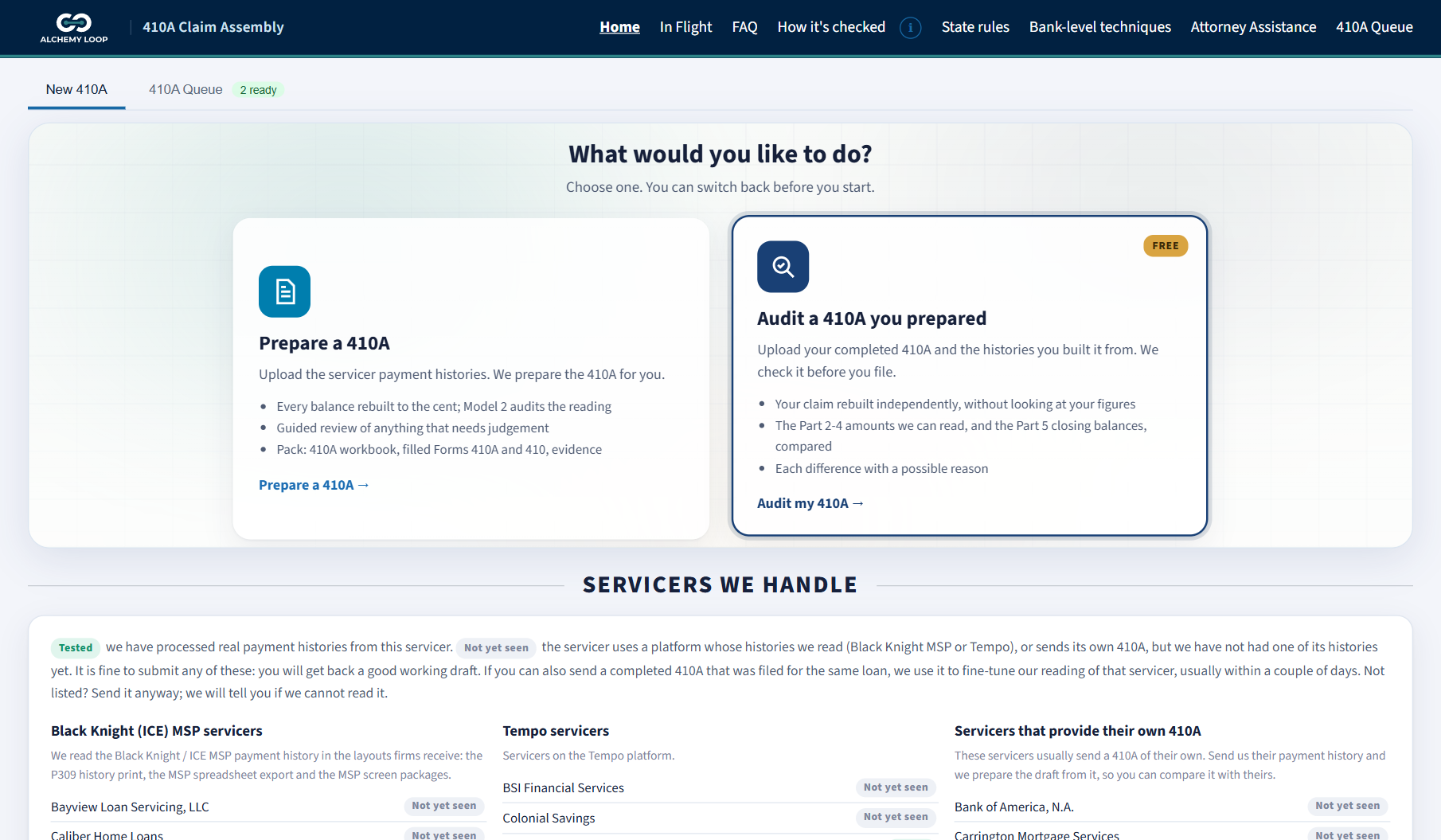
Reconciliation standard
Bank-level reconciliation, down to the penny.
The same disciplines used in bank reconciliation and financial audit are applied to the full population—not a sample. Every amount stays tied to its source, its calculation and the review decision behind it.
One proven ledger builds the entire form.
- Every transaction is classified and tied to the file and page where it appears.
- Principal, interest, escrow, fees, advances and suspense are rolled forward row by row.
- Parts 2, 3 and 5 are calculated from the same ledger, so their closing figures remain connected.
- Each result is labelled as extracted, calculated, supplied, missing or requiring review.
Independent techniques challenge the reading and the arithmetic.
- Every printed amount is ticked and tied back to the page; unmatched amounts become exceptions.
- Running balances and printed control totals are rebuilt with zero tolerance—even one cent is reported.
- Coverage, page sequence, payment order, rates and supporting records are tested for gaps or conflicts.
- A second calculation and independent model re-reading feed a ranked human review and fingerprinted run record.
- 01Source records
- 02Ledger roll-forward
- 03Independent audit
- 04Reviewer sign-off
Six verification layers
No figure reaches the draft on a single reading.
The models help read and challenge. Fixed calculations prove balances and verify challenges. A person keeps authority over every item that needs judgment.
Every page read
Amounts printed on each page are matched to transactions; anything left over is listed.
Every column proven
Principal, interest, escrow, fees and suspense are tested against the servicer's balances rather than assumed.
Balances rebuilt to the cent
Running balances are recalculated and every break from the printed history is reported.
An independent second audit
A separate model reads the same pages and challenges the first interpretation.
Every challenge verified
Code checks each challenge against the page before it reaches the reviewer.
Your team decides
Flagged items are prioritised for a person; the system prepares a draft and does not make the filing decision.
State-specific claim controls
State rules, applied and explained, on every 410A.
The 410A is a federal form, but what a servicer can claim depends on the state. We now check the property’s state law on every claim and show you exactly what we did.
Late-charge limits, fee bans, attorney-fee caps, interest after a foreclosure judgment: the rules change at the state line, and they change what goes on the 410A.
The upload page now asks for the property’s state first; it’s required. We confirm it against the property address in the servicer’s documents. If the two don’t match, we flag it at the top of the pack and apply no state rules until it’s settled.
FHA and VA rules are built into the calculations, too. When the loan programme and required conditions are confirmed, the applicable federal limits are calculated alongside the state rules. Anything that cannot be confirmed is identified for review rather than silently applied.
Every pack ends with a State rules page that shows:
- Which state we used, and how we know.
- Your entry and, where the documents print it, the page where the address appears.
- Every rule we checked.
- Each rule is shown with its legal citation.
- What each rule did to this claim.
- Every effect is shown to the dollar. For example, late charges over the state’s cap are taken off and shown beside the original charge.
- What we couldn’t decide.
- We list it for you, with what’s missing and how much is at stake. We never apply a rule we can’t confirm.
- All 50 states, DC and Puerto Rico researched, with FHA and VA rules built into the calculations and investor fee allowances flagged for review
- Late-charge timing and caps, and fee bans, applied when the conditions are confirmed; attorney-fee limits and judgment interest flagged for your review
- Only the questions your state needs: pick the state, answer two or three, and “Not sure” is fine
- Property state confirmed against the documents, with any conflict flagged before anything is applied
- Nothing erased: every adjustment shows next to the original figure and ties to Parts 2 and 3
- A versioned rule set, reviewed on a regular schedule, with the version printed in every pack
Maryland example
For Maryland loans, we check:
- Late charges only after 15 days
- The 5% late-charge cap, once per late payment
- Property inspection fees, which are not claimed
- Property preservation, not claimed per your instruction
- Escrow interest, flagged for review
These rules help your review and reflect our research as of the version shown in each pack. They’re not legal advice; your firm remains responsible for the claim.
One ZIP · Six spreadsheets
The claim, the evidence and the review list stay together.
The first two files map to the form. The remaining files show the fees, exceptions, underlying transactions and independent audit findings behind it.
Open the illustrative workbook to see how the claim figures, payment history and supporting review detail are organised for verification.
Download .xlsx ↓Parts 1-4
The main form figures, their status and how each value was worked out.
Part 5 payment history
The form's 17 columns from the first date of default, with the source retained for each row.
Fees itemised
Servicer fees, firm attorney fees and costs, including anything excluded and the reason.
Please Check
The short review list: serious items first, then confirmations and supporting notes.
Transactions
Every transaction split into its parts, with the source file and page.
Second Auditor findings
Each independent challenge, the page evidence and the verified outcome.
Illustrative sample. The workbook demonstrates the review structure without using client or production data.
Attorney fees included
Keep firm fees in the same package—without mixing them into the servicer check.
Upload the firm fee sheet with the histories. Eligible claimed rows flow into the draft and Part 5, while possible duplicates, unknowns and excluded rows are held out and explained for review.
- Credits and write-offs reduce the total.
- Possible duplicate corporate advances are flagged as serious.
- Unknown or incomplete rows are never silently claimed.
- Invoice lines must reconcile to the supplied total.
Who it is for
For teams that repeatedly have to prove what a mortgage history means.
Bankruptcy is the centre of the workflow, but the same reconstruction and checking problem appears wherever payment histories drive a consequential figure.
Bankruptcy firms
Prepare creditor mortgage proofs of claim and supporting schedules.
Servicers and subservicers
Reconcile transferred histories and review claim figures before submission.
Chapter 13 trustees
Review the histories and calculations supporting filed mortgage claims.
Debtors’ attorneys
Check the creditor's claim against the payment history and source records.
Foreclosure and servicing counsel
Reconstruct payment histories for reinstatement, payoff and judgment work.
Audit and advisory teams
Trace balances, fees, escrow activity and exceptions during reviews and disputes.
Your team retains the legal judgment
A prepared draft—not an automatic filing.
Recoverability, escrow shortage, any item marked for review and the final filing remain with the responsible professional. Uploaded files are held while the job runs and destroyed after the completed package is downloaded.
UPLOAD→READ & RECONCILE→SECOND AUDIT→HUMAN REVIEW
410A Claim Assembly
See it work on a closed claim.
Compare the assembled package line by line with the 410A your team filed.